
• Skip navigation
  • Skip to navigation
  • Skip to the bottom
Simulate organization breadcrumb open Simulate organization breadcrumb close
Institute of Glass and Ceramics
  • FAUTo the central FAU website
  1. Friedrich-Alexander University
  2. Faculty of Engineering
  3. Department of Materials Science
Suche öffnen
  • Campo
  • StudOn
  • FAUdir
  • Jobs
  • Map
  • Help
  1. Friedrich-Alexander University
  2. Faculty of Engineering
  3. Department of Materials Science

Institute of Glass and Ceramics

Navigation Navigation close
  • Staff
  • Students
    • Teaching
    • BSc / MSc Thesis Projects
    • Grants
    • International student exchange
    • How to become a HiWi
    • Job opportunities
    Portal Students
  • Research
    • Research Groups
      • Functional Ceramics
      • Glass
      • Advanced Ceramics Manufacturing
      • The Wolf Group
    • Research Projects
    • Collaboration
    Portal Research
  • Publications
    • Scientific
    • Annual Reports
    Portal Publications
  • Service
  • Calendar
  • News
  • Contact
    • Address
    • Alumni
    • Maps
    Portal Contact
  1. Home
  2. Students
  3. BSc / MSc Thesis Projects
  4. Stress-Induced Phase Transitions in Polycrystalline BaCaTiZrO3

Stress-Induced Phase Transitions in Polycrystalline BaCaTiZrO3

In page navigation: Students
  • BSc / MSc Thesis Projects
    • Stress-Induced Phase Transitions in Polycrystalline BaCaTiZrO3
    • Temperature and Stress Dependent Flexoelectricity in Perovskite Ferroelectrics
  • Grants
  • How to become a HiWi
  • Job opportunities
  • Teaching

Stress-Induced Phase Transitions in Polycrystalline BaCaTiZrO3

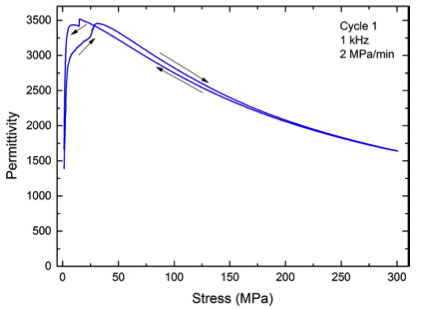
Field induced phase transitions are an important phenomena in ferroelectric materials. They have been extensively shown in single crystal ferroelectrics, such as Pb(Mg1/3Nb2/3)O3–xPbTiO3, but are more difficult to observe in polycrystalline samples due to the random orientation of the crystallite grains. Recent measurements have shown an apparent compressive stress-induced phase transition in polycrystalline BCZT ceramics at room temperature, indicated by a jump in the permittivity at approximately – 20 MPa (Fig. 1).
Untitled
Figure 1. Permittivity as a function of compressive stress for BCZT.

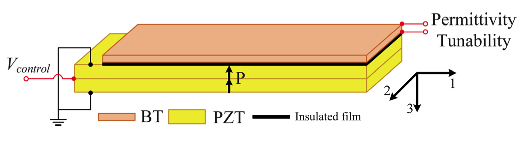
During this project, this anomaly will be investigated using stress dependent dielectric and piezoelectric characterization techniques as well as stress-dependent structural investigations. An additional goal will be to utilize the soft nature of BCZT to develop a highly tunable bimorph heterostructure (Fig.2).
Untitled2
Figure 2. Bimorph actuator used to tune the permittivity of a thin BaTiO3 film.


Further Information
1. Liu and Ren “Large Piezoelectric Effect in Pb-Free Ceramics” Physical Review Letters, vol 103 (2009)
2. Schader et al. “Influence of uniaxial stress on the ferroelectric-to-paraelectric phase change in barium titanate” Journal of Applied Physics, vol 113 (2013)
3. Ci et al. “Large electrical manipulation of permittivity in BaTiO3 and Pb(Zr,Ti)O3 bimorph heterostructure” Applied Physics Letters, vol 105 (2014)

Contact Information
Prof. Kyle G. Webber

Friedrich-Alexander-Universität
Erlangen-Nürnberg

Schlossplatz 4
91054 Erlangen
  • Imprint
  • Privacy
  • Accessibility
  • Facebook
  • RSS Feed
  • Twitter
  • Xing
Up